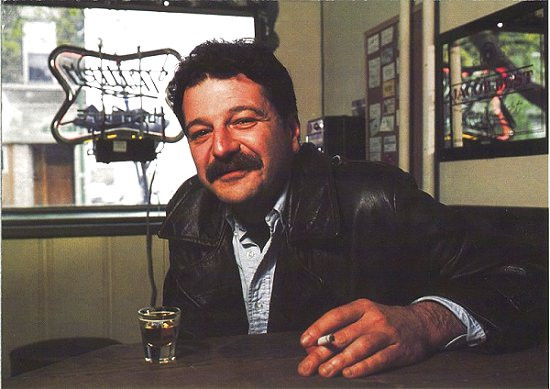
Paul Geremia talking |
| Back
to the Books and Other Writing page Back to the Archive Contents page Excerpts from an interview by Elijah Wald in 1992.
There is a stereotype, I think, that comes to people's minds, white audiences especially, concerning blues. They don't know quite how to handle the blues thing, how to think about it. They think of it as the "intense brooding of John Lee Hooker" or something like that. They don't see the humor. That's probably because they haven't seen a lot of the original people playing the music live. Like Howlin' Wolf, he put a lot of humor into his show, and Muddy had a lot of humor in his lyrics. It's funny that that kind of stuff - there's a communications gap, a generation gap, and furthermore Black audiences for the most part, the Black music audience isn't really interested in blues for the most part. At least, I certainly don't play to too many black audiences. I know that there's a lot of Black people that are interested in it, but it's like, I was talking to someone about that recently, and they were saying, yeah, Black people don't seem to be interested. I said "Well, they never were interested. They didn't want to hear about Muddy Waters or any of that stuff. In the '60s, I remember Black people saying, I don't want to listen to that Muddy Waters stuff. They wanted to hear jazz, they wanted to hear someone who represented a successful Black American. It's like, how many Italian Americans want to hear the real old Italian music, or how many Irish people really care about real, traditional Irish music. They'd rather hear somebody sing Danny Boy, for the most part. Italians would rather hear Frank Sinatra. Well, Black people would rather see Michael Jackson, or somebody who represents a contemporary phenomenon, somebody rolling in dough who represents the epitome of the American dream. Listening to some old blues singer does not represent something that Black people who are still struggling want to identify with. In the '60s, what a lot of people forget is that it was even more so. You had the civil rights movement, you had people really trying to put the whole image, mistakenly in my opinion, put down what was, in their eyes, Uncle Tomism. Mississippi John Hurt was not something they would aspire to. They didn't want that to serve as a model of where they were at, and so they mistakenly pushed it aside with the old Amos and Andy tapes. Now that Black culture is becoming something that people are made aware of, they're digging up a lot of this old stuff and there is an awareness of it to the point that I find myself giving guitar lessons to Black people at times. You find Black people who are interested, even to the point of playing the music and really getting involved in it. And that's great, but it's never going to replace what the tendency is in this country, which is for people to gravitate towards success and wealth and material gain, which is not something that's represented in this kind of music. It's not represented in any real traditional form. I think ethnic groups who are still struggling to be "successful Americans" don't want to be reminded of the traditional thing that they came from. Italians want to hear Frank Sinatra, they don't want to hear some traditional musician who plays a bagpipe. That's just a human thing. It has nothing to do with Black people or white people. It's just the way people are. The ironic thing about it is that in the '60s it was white people who kept the ball rolling and got into reviving the music. Not only was it white guys who went down there and found the old musicians and brought them out of obscurity to white audiences, but there was also these same white guys who were playing the country blues and keeping it interesting. If it hadn't been for the interest of John Fahey and some of these guys who actually went out and found these guys, you probably wouldn't have had a revival. If John Hurt hadn't played the Newport Folk Festival in '63 and gotten a really positive response, I don't think you would have had the '64 festival, with all these guys being there. I mean, I can't speak authoritatively about what would have happened, but the '64 Newport Folk Festival was for me an unbelievable experience. I've never been impressed by anything as much as I was impressed by that workshop Sam Charters did that Saturday. It was just amazing. Skip James, Sleepy John, Yank Rachell, Robert Pete Williams, Rev. Robert Wilkins—all these guys who you never thought you'd be seeing. I got into learning to fingerpick about a year or so before that. It was difficult to learn. They didn't have the recordings available. I waited almost a year before I got a recording of John Hurt after I first heard him. You couldn't get the records. He wasn't with Vanguard. He was being put out by a little company in Maryland that Tom Hoskins had. The information just wasn't available. It's hard to imagine that. There was no Yazoo records. You couldn't go into a record store and find all that stuff. Maybe in Harvard Square, you could find a Folkways anthology. When I went to Cambridge for the first time, around '63, I couldn't believe the stuff that was going on. That stuff was around, but you didn't know it, it was very hard to find. Now, there are a lot of people playing for the fun of it, but very few making a living at it. Doing something for the fun of it and making a living at it are a whole different ballgame. I'd say some of the best country blues scholars I know are not people who make their living playing music. I think they'd be scared shitless to get up on stage, but they know a lot about the music, and they can take things off record note for note. I learned a lot from people like that. I learned a lot about playing, and improved a lot when I got to hanging out with people like that. Not that there's many of them, but people like Mike Stewart. I spent a day or two hanging out with him, and he gave me tapes of recordings that he had, and it gave me a real shot in the arm. It reinforced my enthusiasm. Because, at that time, to think that you could go ahead and do this was kind of crazy. Cause in the early '70s, trying to make a living of this was really difficult. So he came along at the right time. It was also around that time I met Pink Anderson, too. You've got to think about what the guys did who played the music. How they made a living with the music is a good way to approach it. When I play, people don't usually dance to what I'm doing, even if I'm playing a song that people used to dance to 50-60 years ago. Once in a while, something will happen - I'll be playing a bar where people get into it, I've had people dancing to some of my stuff. And I wish people would do it more often. I think it would be a great thing, to get people dancing to an acoustic blues sound. Cause the rhythm is there, it’s just not as loud as a dance band. Most people figure music isn't for dancing unless it’s so loud they need earplugs. [What the old musicians played.] You have to remember, what we're hearing is the tip of the iceberg. We don't know what those old-time musicians were influenced by. For instance. I got a xerox of a piece of sheet music from the eighteen hundreds, mid 1800s, of a song called See That My Grave is Kept Green. Now I'm saying to myself, Oh, that's where Blind Lemon got see that my grave is kept Clean. But maybe not. You don't know. You don't know what they were listening to. There was so much music around, of different genres and different types. There was a minstrel show tradition, a medicine show tradition, where they did all kinds of stuff. There was take-offs on popular tunes that got into the country blues and old-time music thing. Charlie Poole's stuff, a lot of that was popular tunes of the time, done with a string band. It was just entertainment, part of what became the vaudeville tradition. If it was done by a string band, people think, Oh, this is real traditional music, this is mountain music. No, it was written by a tin pan alley songwriter in New York city. It wasn't written by some guy sitting by a whiskey still in a hollow in West Virginia. [On Robert Johnson] I really like Robert Johnson material. I was doing it for years, but I feel as though there's a lot of other stuff that people haven't heard that I like to turn people onto, that I get just as much fun out of playing, and that means as much to me. The other thing is, in order to do it right, and play it the way I like to play it, I like to tune my guitar up to an A, open A tuning, instead of open G. My other guitar, I used to be able to do that, but this guitar, it's just too much tension. And also, I always break strings when I do it on that other guitar. So that's the main reason, because I haven't been using that guitar that I can tune up to A and not worry about breaking strings all the time. Also, there's only so much material that I want to do in one tuning in the course of a night, and I’ve been doing “My Kinda Place” and a couple of other things, and I guess I just got tired of playing it. Another reason I haven't been doing that much Robert Johnson is because I've been doing a lot of stuff playing slide on the twelve-string guitar, and I only want to do so much slide in the course of a show, so I'd rather do the stuff on the twelve string, because it's more different, it's more original for me, it's got a lot of my own stuff involved in it, my own material. And the twelve-string, I don't have to worry about breaking strings; nobody's gonna get hit in the eye with a bridge pin. I don't break strings on the twelve unless I leave 'em on too long. I broke one the other night. I usually break the D octave, even though it's pretty heavy, I use a 16 or a 17 for an octave on the D string, and actually it's tuned down to a Bb, but it still breaks. [About the singer-songwriter trend.] It's a very personal thing, everybody has their own musical enthusiasm, but I personally get as much satisfaction out of playing an old song that means a lot to me as I do from playing one of the songs I have written, especially when I feel as though I am reinterpreting it and maintaining the connection. Also, you've only got so much time to play on a stage, and I feel like it's better to include as much variation and as much entertainment value for the audience as possible. I could spend a whole night doing nothing but my own stuff, but I'd personally find it kind of boring and a little presumptuous to give my own thing the whole trip. And there's a whole other dimension to what I do. If I did a whole night of my own stuff, I know there's a whole other dimension of stuff that I've come from that that audience deserves to know about.On the other hand, I'm in a quandary about this a lot of the time, especially when it comes time to make a record, because I say to myself, shit, I really would like to do my 12-string guitar and play my arrangement - my arrangement, I should say, an arrangement - of Special Rider blues, which is almost identical to what Skip James did, except it's in a different key, it's gonna sound a whole lot different cause I'm using a twelve-string guitar and I do play it different than Skip James did. But I'm saying, why the hell do I want to do that when I can hear a Skip James recording of the song? So, you find yourself in a situation where you say, well, when I play live I play a mixture of the old stuff, when I do a record I’m going to do the same thing, but why would people buy a recording of Paul Geremia playing this song when they can buy a recording of the original? You know, I can play any of those songs note for note like they were done by the original guy, but I don't do that either when I perform or when I record. But this is an important point: there are certain songs that you cannot perform without doing them identically to the way they were done. Just by the nature of the way the melody goes and the nature of the guitar. For example, Special Rider Blues, in my opinion, I don't see any way of getting around doing it without sounding like Skip James. What we're getting down to is, a lot of people don't feel there's any artistic merit to taking an old song and redoing it—or not as much artistic merit as there is in doing your own song. Basically, I think that's a whole lot of bullshit. There is a lot of merit to both those things. It's just a question of how well you do it. It's a question of what your interests are, and what the public is interested in, more to the point. I find that, as a singer, there are certain things that I want to say and if I can say them with old time music, that's fine with me. If there's something that I need to say that I can't find in old time songs, I'll write a song that says what I want to say. There are certain songs that I've written that I definitely include, no matter what, because they say what I want to say, they have contemporary ideas. But I don't see any point in doing a song I wrote just because I wrote it, as opposed to an old time song because I didn't write it. It's gotta be something that says something which can't be said with an old time song. There were certain issues that were not addressed 50 or 60 years ago, and I think it's the duty of a musician, whether he considers himself a songwriter or not, to try to express contemporary ideas, not necessarily as a songwriter per se, but as an interpreter of the music, and try to make it apply to today. You can't sing a song addressing contemporary problems using lyrics that were written 60 years ago, but you can address emotional feelings that haven't changed in 50 or 60 years using an old time song. I feel the most amount of satisfaction, as far as a songwriter capacity goes, from the songs that sound more like old-time tunes. “My Kind Of Place,” “Kick it in the Country,” “Diggin' Uncle Sam's Backyard,” stuff like that. For example, “The Things That Used To Matter,” which I'm going to put on the next record. It uses a blues accompaniment, and it's nothing outrageous in terms of the accompaniment, it's traditional-sounding, but the lyrics definitely apply to what's going on today. On the other hand, I've written songs that, I think they're good by contemporary standards, but the content and what they're addressing isn't something that I always feel is necessary for me to convey to an audience. So if I have a new thing that I've worked up from old-time music, I prefer to do that. It's just a question of me doing the best job that I can to entertain people and at the same time convey as much about what I'm interested in. I think the problem with me regarding my attitude about the whole thing is that although the whole folk music thing started out as an alternative thing, whereby people did stuff regardless of what the "trend" was, it's evolved to the point where there are now trends within that whole framework. Years ago, people were just doing what they wanted to do, because that's what audiences expected. All people wanted from the folk music revival and the blues revival was to hear something different than what was happening, because they were bored with what was happening. But the renegade musicians have created sort of an underground thing over the years and now that's become an industry itself which is threatening to usurp that attitude, which is the whole thing that started it. Now you've got folksingers who've got computers and mailing lists and agents and managers who are specifically marketing these acts to appeal to the "underground" audience. It's pretty interesting from that regard, and it's also frustrating at times, because I don't like the idea of thinking of myself as someone who has to "market" himself. I don't design what I do to a market. I don't like to think in that way. But when you're out there and you're playing in front of an audience, all of a sudden it hits you: Yeah, these people are being conditioned. There are business heads out there who are doing just that. The difference between what I do and a lot of the electric blues bands and a lot of the contemporary interpreters of blues, both white and black, is that their frame of reference doesn't go back all that far. They don't go back much before BB King. Whereas the original Chicago blues band musicians, they were coming from Charley Patton, Son House, Robert Johnson and all that sort of thing. Their sound was a whole lot more varied and a whole lot more unique, more what you';d think of as being individual than what you get today, which is becoming more and more diluted to the point where there are Black musicians playing in Chicago today who never heard Son House. They're not interested, because they don't see how it relates, they don't make the connection. They're more concerned with having a contemporary sound. Which again goes back to what I was saying about marketing. You can say, “Well, the old music is there, it will always be there, people can always find the recordings of the old music if they want to, so it's not important to play that now. But what is important is establishing an individuality, a sort of uniqueness with your music, and not just repeating the mistakes of pop music. Like for instance turning into a bland form of pop music, which is what the singer/songwriter thing has turned into. It's getting farther and farther away from what was there. [Going back and listening to the old stuff.] I go through periods when I don't listen at all, for a long time. When I started there were no tablature books, and there were precious little recordings around, and so it wasn't until I actually had access to a lot of stuff, and I went through a period in the early '70s when I was really listening to a lot of stuff, and it was really frustrating, cause all of a sudden I realized, god, there is a lot of stuff that I never had a chance to hear before, and I've got to absorb all this stuff, and it's enough to make you crazy. I still go through times when I'll go back and listen to certain things, just to remember where I came from, what my "roots" were, whatever you want to call it. And I always learn something when I go back. The whole thing, in a nutshell, is you just absorb as much as you can. You hear certain music and you absorb it, and, eventually, if you really have the enthusiasm for it, you’ll have an idea in your head about trying to say something musically. Like you'll be driving along—this happens to me a lot—I’ll be driving along in my car and I get an idea about something and come up with a lyric, and almost simultaneously I'll find it falling into some kind of a rhythm, some kind of a riff will seem to come around in my head. Like “Diggin Uncle Sam's Backyard,” that fell right into that piedmont style, real easily. And sometimes I'll be driving along and I'll think of the same lyrical thing in terms of a three-chord country thing. There's lots of ways you can write songs. It's just a question of what your particular enthusiasm is or what notes are rolling round in your head from what you've listened to. It's kind of neat, because the good thing about being a songwriter who has an interest in traditional music is that it's nice to see how these things come together in an unpredictable sort of a way. Sometimes it'll work and sometimes it doesn't work. I've got songs that have really irritated me, because I've almost got it, but there's something missing, it doesn't quite make it, and I think, dammit, that should work, but it doesn't quite work. And sometimes it just falls together just right. There are all these elements. Because, let's face it, there's very little that's "original" that's gonna come from anybody in any musical form. You're gonna have musical ideas that you've absorbed. You can listen to Blind Lemon Jefferson till you're blue in the face and not be happy with what you're doing with it, but one of these days something's gonna come out of your consciousness, from your imagination, that is gonna contain elements of that stuff you have listened to. That happens with me sometimes: I come up with something and say, “That's interesting, I haven't played that before,” and then a week later I'll be playing it and I'll go “Oh, yeah, I know where, that's a little snippet from this or that.” I think it's unfortunate if a person's interest in country blues, for instance, is such that all they do is straight rehashing of the old stuff, because that's not what the old guys were doing. They were actually mixing it up and changing things around and coming up with things that did sound a little bit different. And that's basically what the whole thing is about. It is about creativity. Not that there isn't creativity inherent in playing old songs. I don't think people should feel like there is not much merit in that. That attitude is what has created the singer/songwriter thing and caused the singer/songwriter thing to burn out as fast as it has. Like, this article you’re doing is going to have tablature for one of my songs in it, and that's ok, I suppose it's good to have those kinds of things. They are short cuts to learning things and if I'd had access to stuff like that 25 years ago, I would have taken advantage of it for sure. On the other hand, there's probably more of a tendency, because of tablature, for people to be content with that and not to accidentally come across with their own style, as they did years ago. I don't think there's anything wrong with someone absorbing influences, whether they come from radio or from a phonograph record and incorporating them into what they do. It's just a question of what makes sense. But on the other hand, that's not to say that I'm about to record Beatles songs and Grateful Dead songs. There's all kinds of songs out there. I'm not about to do that, because I like the old sound. I like to sort of think of myself as some sort of a forensic musicologist, who goes back and hears something that he really likes and he can figure out what it is and just stack it in my head and sometime regurgitate it in a way that makes sense. Not necessarily in the context of the way it was done originally, but in some way that works for me. I guess what I try to do is take influences and absorb them and come up with something that sounds right to me. Don't ask me what “right” is, but I like to think that I know the difference between right and wrong and I like to think that when I'm playing something and I'm happy with it, it's right. It makes sense to me. I get a kick out of turning the audience on and having them really enjoy listening to something that they never heard before or that they didn't expect. And there's more to that than regurgitating stuff I've learned. That whole thing about it just sounding "right"—I don't know what that means, but there are musicians that I've heard who regurgitate old stuff and it just sounds like that, it sounds like it's notes and it doesn't have that other thing that goes with it. That's true of country blues players, that's also true of jazz people. It's not a question of authenticity, because I don't think of myself as being an authentic anything, except an authentic Paul Geremia. The idea of authenticity, that goes out the window to begin with, that's not important. I don't think that was ever important. It's just a question of somehow feeling as though you're remaining within the confines of a musical tradition and at the same time expanding on it somehow. Almost like you're trying to create what the logical extension of a style would be. You like to think that, if one of the old-timers came back to life and heard you playing the way you do one of their tunes, one of the songs from their style, that they would like it. You do have to find your own voice, so to speak, and that's really what Robert Johnson was doing when he was listening to Leroy Carr and absorbing things that he did, even though he probably never saw him, and he probably never saw Scrapper Blackwell, but he was definitely doing their thing. I've never seen Blind Blake, but I've definitely been influenced by him. I don't think it's essential that you have to experience first-hand what's going on. Once phonograph records started being manufactured, that pretty much replaced a lot of that and spread the music from then on. On the other hand, I do feel as though having seen some of the old-time players makes a difference in terms of how you look at the music. It can't help but make a difference, in terms of your attitude about it. Because you had a chance to see how something was done and pick up on nuances that maybe didn't come across on a recording. Certain things that happened on recordings that won't compare to seeing someone play live. That's the nice thing about seeing live performances, is that what's being conveyed is visual as well as musical. There are certain things which you say lyrically, the total impact of which can't come across through an audible reproduction, because there's a certain sense of humor or whatever, subtleties that are gonna come across that can't come from records. For example, when you listen to a Charley Patton record, you know you're only getting a small portion of what he was really doing. That guy had all kinds of things that was going on.
By Elijah Wald © 2020 |